
Tour operator website development that keeps up with your departures
Short answer: We build tour operator websites with day by day itineraries, departure dates, inclusions and an enquiry that carries the tour name and pax count to your WhatsApp. Plans cost ₹8,000, ₹12,000 with an admin panel or ₹16,000 with online payments, and a full travel portal is ₹45,000. The first year of hosting, domain and maintenance is free.
Running fixed departures is an inventory problem before it is a design problem. Dates fill, prices change by season, one trip sells out while another needs pushing, and the website is usually the last thing to hear about it. Then a customer enquires about a departure that closed three weeks ago.
We build tour operator sites where updating a departure takes a minute, not an email to a developer. Tour listings, seasonal pricing, availability status and an enquiry flow that tells you which departure the person is asking about. It is the inventory side of travel agency and tour operator website design, the part most studios skip.
The three things that break on tour operator websites
Almost every operator site we are asked to rescue has failed the same way. It looked fine on launch day and then the business moved and the site did not. These are the three failures, in the order they usually happen. Our tour operator website checklist has the full list.
Departures go stale
Dates from last season sit on the site because changing them means calling a developer. We build the tour as a repeatable template with its own departure list, so adding a date or marking one sold out is a thirty second job you do yourself.
Every tour looks the same
When one layout is stretched over trek, pilgrimage, weekend and international trips, none of them sell. We build a listing that filters by type, duration and price band, so a visitor gets to the four trips they might actually book instead of scrolling past forty.
Enquiries arrive with no context
A form that only sends name, phone and message wastes the first two calls. Ours carries the tour name, the departure date and the pax count into the WhatsApp message or the email, so the first reply can be a real answer.
Operator sites that are live right now
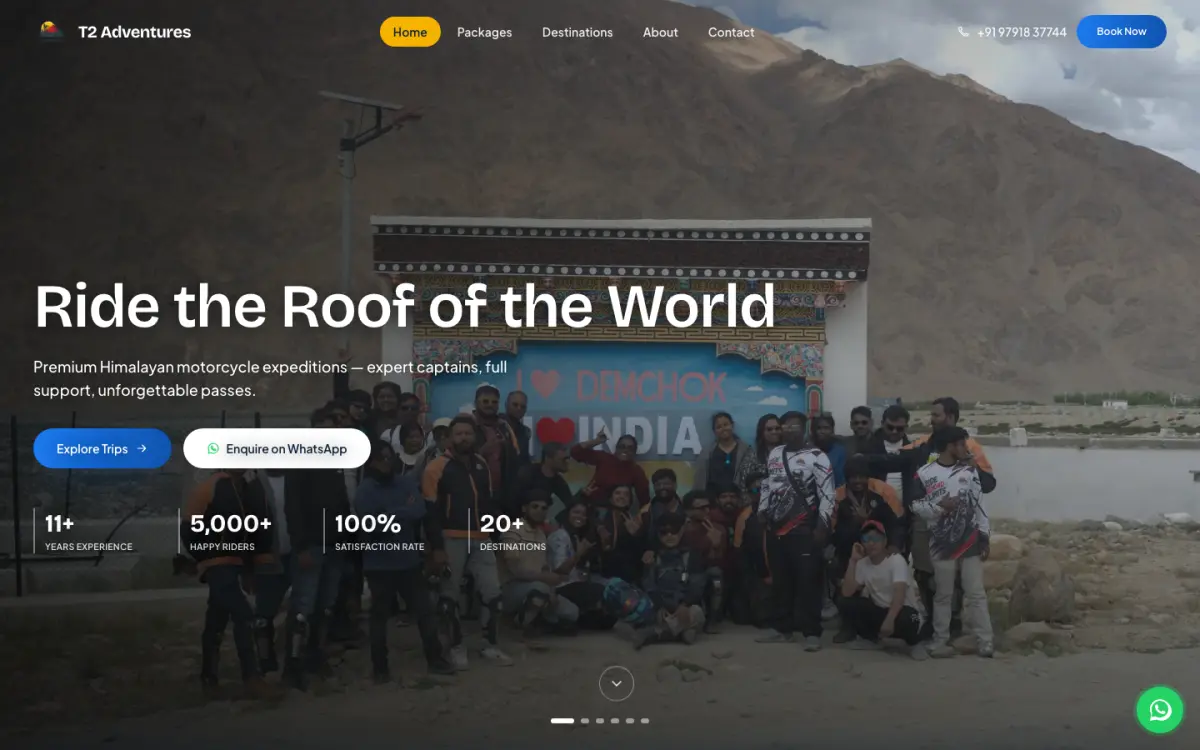
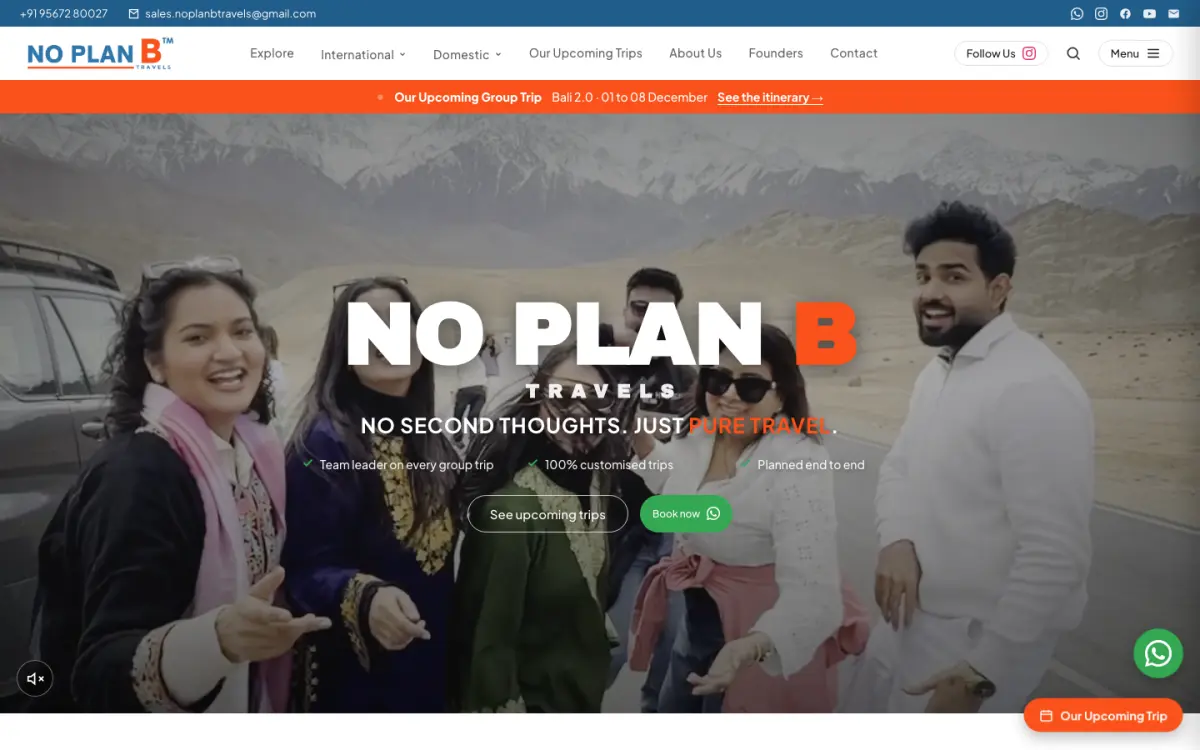
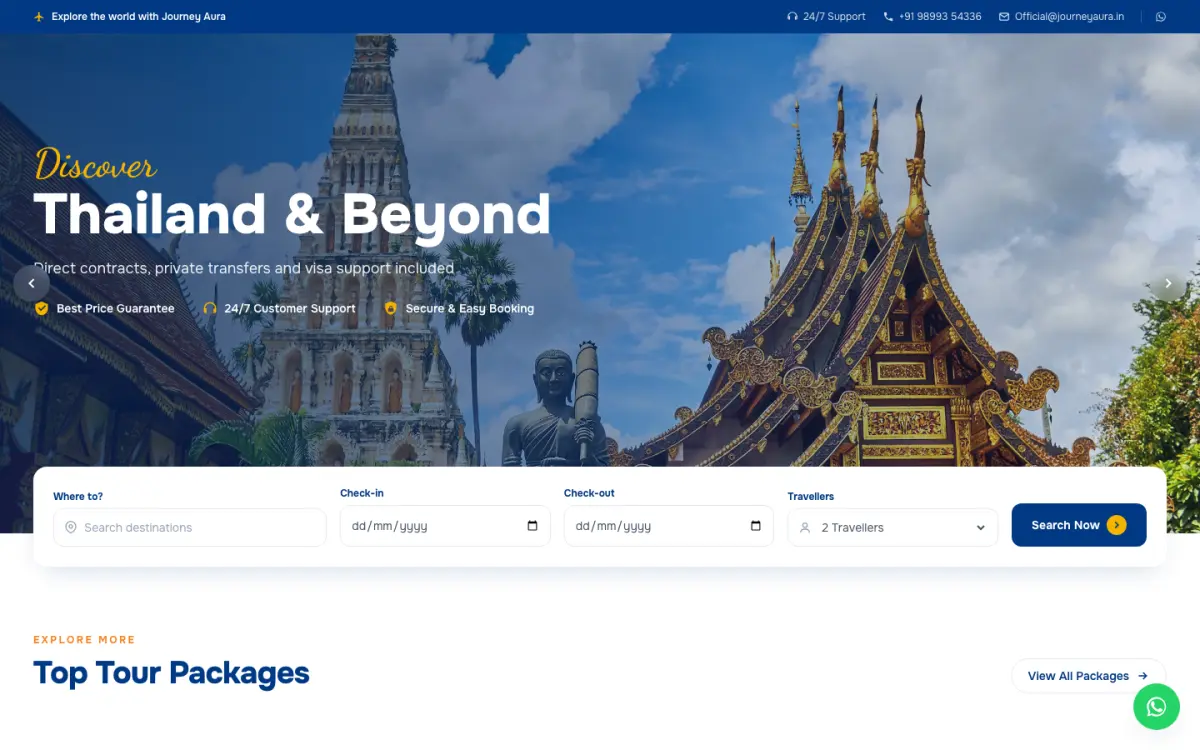
Open these on a phone and try the enquiry path from a tour page, because that is the flow that decides whether an operator site earns its cost. There is more of this work in the portfolio, and reusable versions of these layouts on the templates page.
What is included in a tour operator build
- Tour listing with filters for type, duration and price band
- Reusable tour template with day by day itinerary blocks
- Fixed departure dates with sold out and filling fast states
- Seasonal pricing, twin and triple sharing, child rates
- Inclusions, exclusions, cancellation policy and things to carry
- Enquiry that carries tour name, date and pax into WhatsApp
- Optional admin panel so your team edits tours without a developer
- Printable or downloadable itinerary for the customers who ask for a PDF
A focused operator site on our Basic plan costs ₹8,000. Premium at ₹12,000 adds your own admin panel, so you update departures, prices and photos yourself, plus one dashboard for every enquiry. Professional at ₹16,000 adds online payments straight to your bank and bookings around the clock. A fully custom booking flow is quoted in writing. Full detail on the pricing page.
If you want to move fast, one of our ready made travel designs can be rebranded on the Basic plan and live within a week. It will not have a custom booking flow, but it will have real tour pages and a working enquiry path, which is already more than most operator sites manage. Browse them on the website templates page.
Selling to other agents rather than to travellers changes the whole layout. That case is covered on the DMC website design page. Either way, you can see a free demo of your operator site before paying, and the full list of what we build is on our services page.
Questions we get asked before every project
- Can my team update tours and departures without calling you?
- Yes, with the admin panel option. You log in, edit a tour, change a price, add a departure date or mark one sold out, and the site updates. Without the panel the site is cheaper to build and we handle updates for you over WhatsApp, which suits operators who change dates a few times a season rather than weekly.
- What does a website actually cost?
- Basic is ₹8,000: up to five pages, WhatsApp, call and Instagram buttons, an enquiry form that lands on WhatsApp, Google Maps and SSL. Premium is ₹12,000 and adds your own admin panel to edit packages, prices and photos, an enquiries dashboard and basic SEO setup. Professional is ₹16,000 and adds online payments straight to your bank, bookings around the clock, a reviews section and Google Business and Analytics. The first year of hosting, domain and maintenance is free, then ₹4,000 a year. Anything larger is quoted in writing.
- Do you build online payment and instant booking?
- We build payment collection where it makes sense, usually a booking amount rather than the full trip cost, through a standard Indian gateway. Full inventory backed instant booking is a different scale of project and for most Indian operators it is not worth the cost, because the customer still wants to talk to a person before paying for a trip. We will tell you which side of that line your business falls on.
- How long does a tour operator website take?
- Seven to ten working days for a four to five page site, twelve to fifteen for a site with tour listings and a blog, and twenty to twenty five when a custom booking flow and admin panel are involved. A reskinned template is three to five days.
- Do I need to buy the domain and hosting separately?
- No. Every plan includes the first year of hosting, domain and maintenance free, with the domain in your own name so you own it. From the second year it is ₹4,000 a year for all three together. We set everything up with you and hand over the logins. We never hold your domain hostage.
- Will moving to a new site lose my Google rankings?
- Not if it is done properly. We map every existing URL to its new address and put permanent redirects in place before launch, keep your page titles and content where they are already working, and resubmit the sitemap afterwards. Rankings usually wobble for a week or two and then settle. Losing them for good happens when a site is rebuilt with no redirects at all.
Related pages
If this page is not quite what you are after, one of these will be closer.
Send us your tour list and we will show you how it should be laid out
Message us the trips you run and how often the dates change. We will come back with a structure and a straight price, same working day.